

Marshmallow candy has a long history beginning in Egypt around 2000 BC. The sap was squeezed from mallow plants (Athaea officinalis) that grew in wet marshes and was then whipped into a froth and flavored with nuts and honey. It was a tedious process and the result was only served to the gods and royalty. There is no record of what this candy looked like.
The confection eventually made its way to France in the mid 1800’s where it was a huge success. Candy store owners whipped the mallow sap into fluffy shapes and could barely keep up with the demand. The Starch Mogul system was introduced in 1899. Shapes were pressed into a bed of cornstarch and the mallow fluff was poured into the resulting molds. Around the same time, gelatin was substituted for the mallow sap, which resulted in a more stable form of marshmallows.
The next step in marshmallow history occurred in 1948, when Alex Doumak invented the extrusion method, where the mallow fluff was pushed through tubes and cut into the individual shapes we would recognize today.
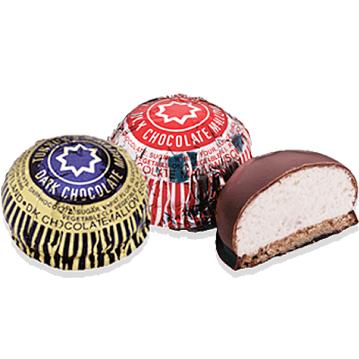
Back in 1890, Thomas Tunnock bought a baker’s shop in Lorne Place, Uddingston, Scotland for £80. In 1950, the bakery, still owned by the Tunnock family, moved to its current site on Old Mill Road, where they specialized in biscuits with a longer shelf life. In 1956, Boyd Tunnock (third generation) developed the Tunnock’s Teacake which was a blend of marshmallow on a biscuit base then coated in chocolate. These teacakes are still popular today.
Fun video on making your own teacakes.
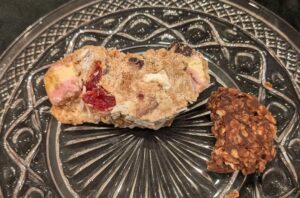
Another favorite Scottish treat with marshmallows is called Fifteens. I’ve heard that this is one of the first things that Scottish children learn to bake. They are super easy and very yummy. They are called “fifteens” because the ingredients call for fifteen of each ingredient. It also helps young children learn to count.
FIFTEENS
 Ingredients:
15 crushed digestive biscuits or graham crackers
15 chopped marshmallows
15 glace cherries
7 oz. Sweetened condensed milk. (half a can)
Desiccated coconut
Mix first four ingredients together and roll into a log. Roll the log in the coconut and roll up in plastic wrap. Chill for several hours then slice into pieces.
Notes:
- Lidl has digestive biscuits and also pink marshmallows which are traditional.
- Use scissors to cut up the cherries and marshmallows.
- Use regular coconut and whizz it in a food processer. This makes smaller pieces that stick better to the roll.
- Other things you could add: candied ginger, chocolate chips, nuts, etc.